This post may contain affiliate links at no additional cost to you. By making your purchases through the links on this website HIGP may make a small percentage at no direct cost to you. HIGP only promotes products we use & truly believe in. As an Amazon Associate I earn from qualifying purchases. Please refer to my Privacy and Disclosures for further information. HIGP thanks you for your support!
Everyone asks what a Bernese Mountain Dog puppy costs. The breeder’s price, the adoption fee — that’s the number people fixate on.
Here’s the truth nobody tells you at the meet-and-greet: the purchase price is the cheapest part of owning a giant breed. It’s the down payment on a decade of supersized bills, and I say that as someone sharing her house (and her bank account) with four of them.
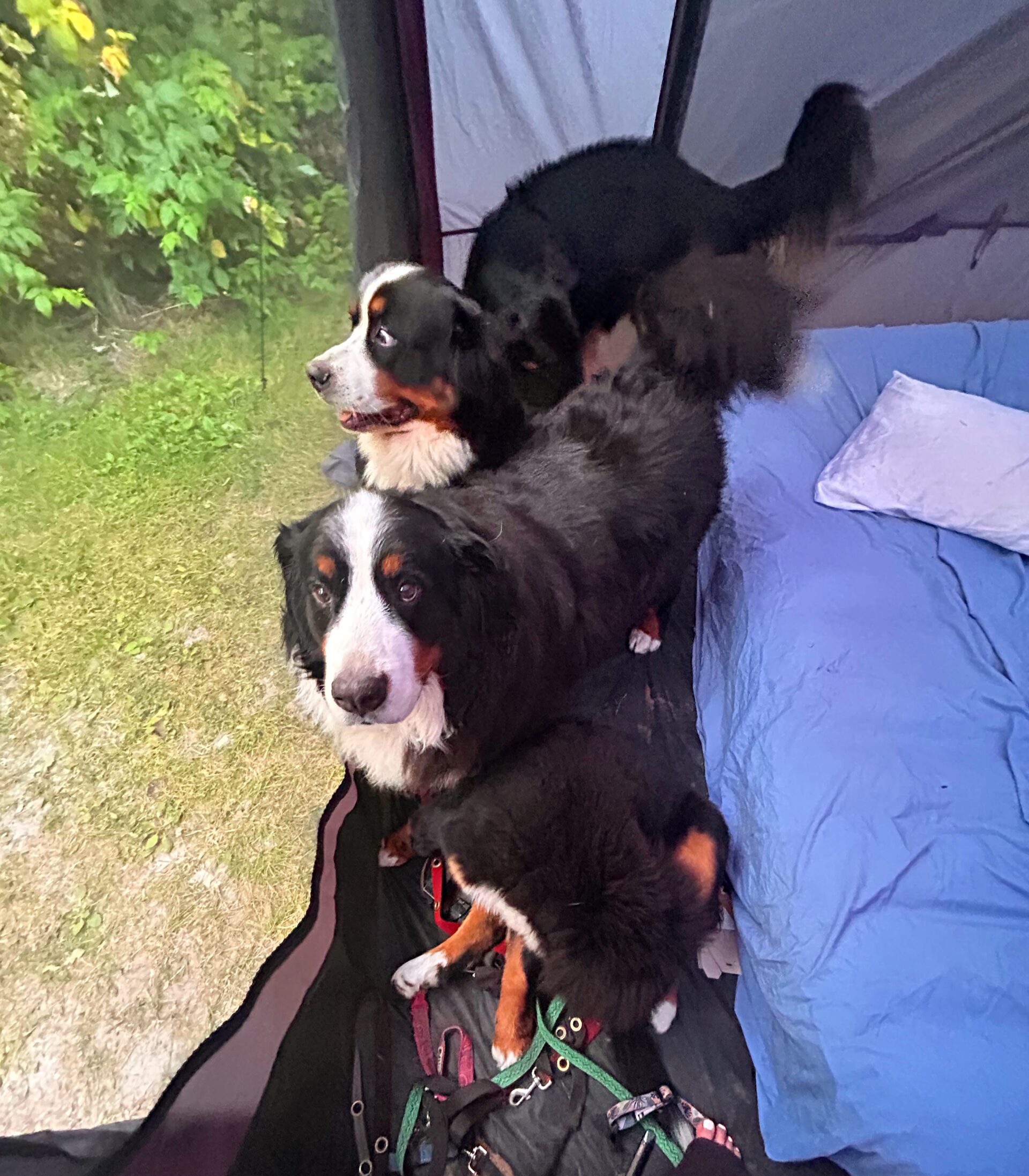
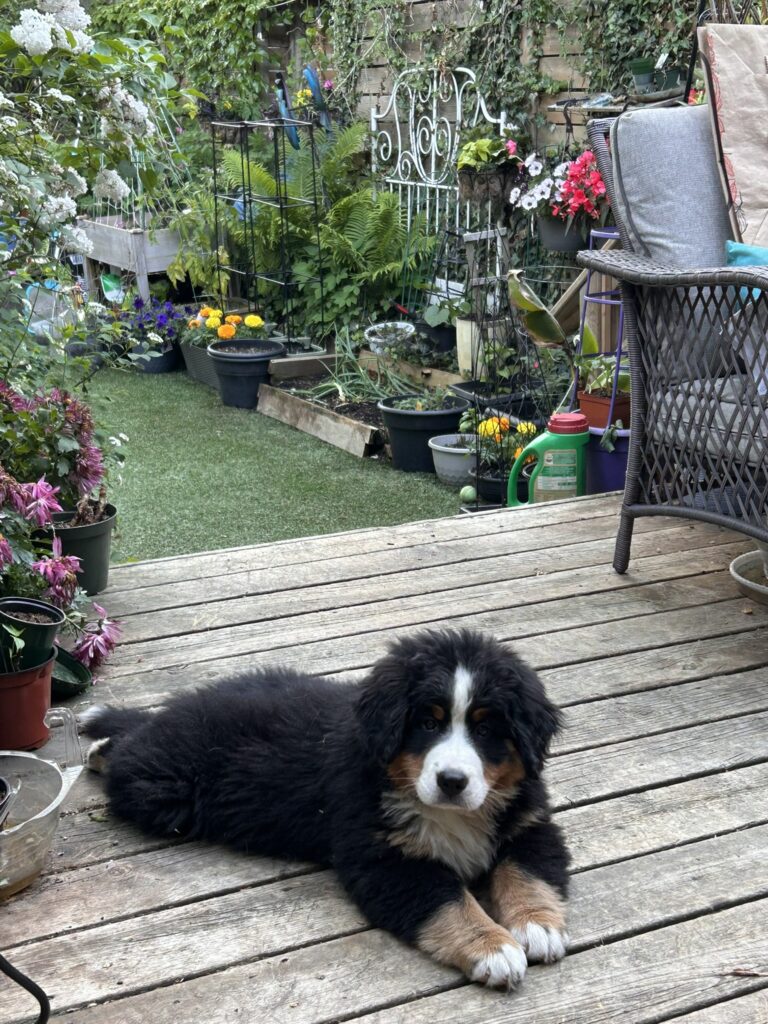
I’ve got three Bernese Mountain Dogs — Grace, Sassy, and Barney — plus Beau, our Bernese-Rottweiler rescue. A comment I get out a lot on walks is “what’s the food bill look like?” or “how much do they eat?” Between the four of them, I’ve paid just about every giant-dog bill that exists. So here’s the honest math: what it costs to bring one home, what it costs every year after, and the five-figure surprises nobody warns you about.
First-Year Costs: Getting Started
| Expense | Typical Cost (CAD) |
|---|---|
| Puppy from a reputable breeder | $2,500–$4,000+ |
| Rescue adoption fee | $300–$600 |
| First-year vetting (vaccines, microchip, deworming) | $400–$700 |
| Spay/neuter (giant breed — anesthesia is dosed by weight) | $345–$1,050+ |
| Giant-breed bed | $55–$135 |
| Collar, harness, leash (giant-size, and you’ll replace the harness as they grow) | $100–$150 |
| Food and water bowls (elevated is nice for tall dogs) | $40–$80 |
| Puppy kindergarten / basic training | $200–$400 |
| Toys and chews (they destroy the cheap ones in minutes) | $150–$250 |
| First-year total (breeder puppy) | $3,750–$6,700+ |
You’ll notice there’s no crate on this list — my dogs free-roam the house. Beau came home from the shelter with such bad anxiety he can’t stand closed doors of any kind, so crates were never an option for us. If yours is a crate dog, add $250–$300 for an XXL one. Grace was the exception to this rule – she LOVED her crate and was very sad when we had to put it away because it was taking up half my bedroom and I had to move it around to get into my closet.
That spay/neuter range is real, by the way. A low-cost clinic might do a large dog for $345–$425, but a full-service vet averages $950–$1,050 for giant breeds in Ontario — anesthesia, monitoring, and meds are all dosed by weight, and there’s a lot more dog to dose.
Annual Costs: The Real Budget
Food: The Biggest Line Item
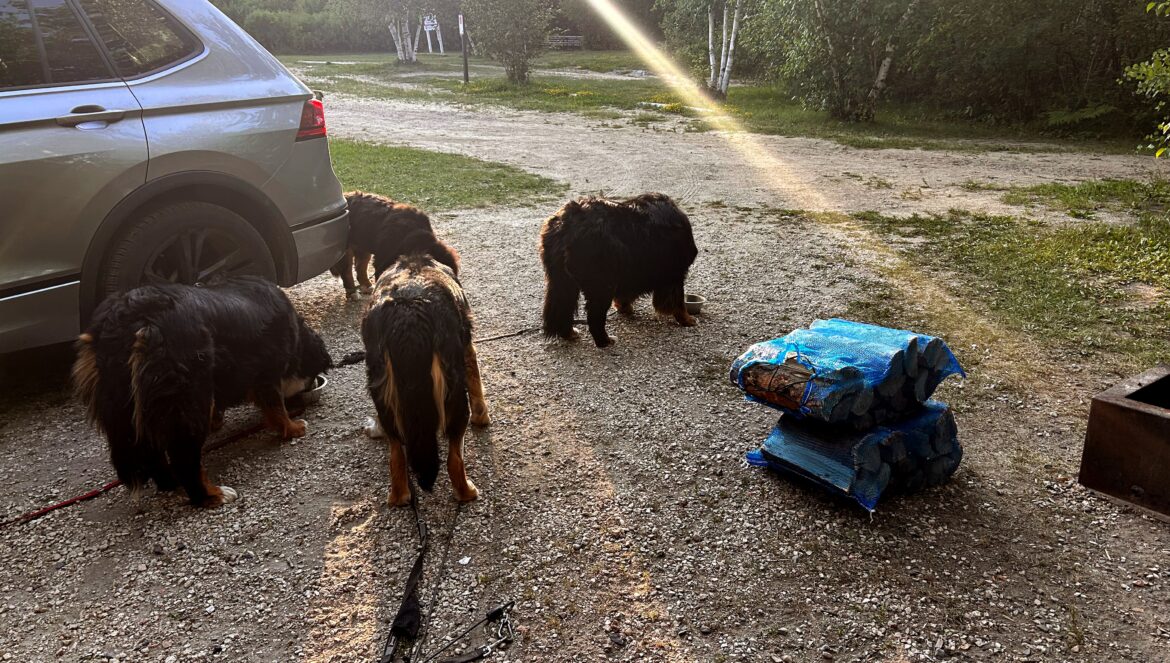
Food is where giant breeds separate from normal dogs fast. A Bernese eats roughly twice what a Lab eats, and the numbers scale with every pound.
Here’s what feeding my four actually looks like, because I think real numbers beat generic advice:
- Barney (puppy): 4 cups a day — a mix of Purina Pro Plan Performance Salmon & Rice and Hill’s Science Diet Large Breed Puppy, plus a homemad topper I batch-cook (ground raw, carrot, and peas).
- Sassy & Beau: 2 cups a day each of Hill’s Science Diet Perfect Weight + Joint Support, the large-breed one.
- Grace: 4 cups a day of her Royal Canin veterinary diet — it’s the one that finally got over 20 lbs off her and is easy on her aging joints.
- All four get Grizzly omega oil daily.
On top of the kibble, they get raw food — about $335 a month from our local raw supplier, delivered weekly. I got lucky there. Most people can’t buy raw at that price, and pet-store raw for giant breeds runs dramatically more — closer to $160–$300+ per dog per month.
For reference, here’s what the kibble alone costs at Canadian retailers:
| Food (largest bag) | Price (CAD) |
|---|---|
| Royal Canin Large Breed Adult, 30 lb | $122–$125 |
| Hill’s Science Diet Large Breed Puppy, 13.6 kg | $110–$116 |
| Hill’s Science Diet Perfect Weight + Joint Support, 11.34 kg | $125–$130 |
| Purina Pro Plan Performance Salmon & Rice, 33 lb | $103–$105 |
| Royal Canin veterinary diet (Grace’s) | $235 a bag |
A single giant dog on premium kibble: $100–$150 a month. On raw from the pet store: $160–$300+ a month. On my supplier’s raw: about $84 a month per dog— a deal I don’t take for granted.
The Annual Table
| Expense | Typical Cost (CAD/year) |
|---|---|
| Food (premium kibble, one giant dog) | $1,200–$1,800 |
| Food (raw, one giant dog) | $1,900–$3,600+ |
| Pet insurance (giant breed — they’re pricey to insure) | $660–$1,260 |
| Routine vet care (exam, vaccines, parasite prevention) | $500–$900 |
| Grooming (professional, per dog per session: $200–$300) | $800–$2,400 |
| Toys, treats, chews | $360–$600 |
| Poop bags (we go through nearly a roll a day) | $150–$250 |
| Annual total (one giant dog) | $3,700–$9,000+ |
About that vet line: we’re at our vet so often they’ve started waiving our visit fees. I wish I were joking. Those are normal Toronto prices in the table — ours are lower because we’re basically regulars with a punch card.
Grooming: The $200–$300 Surprise
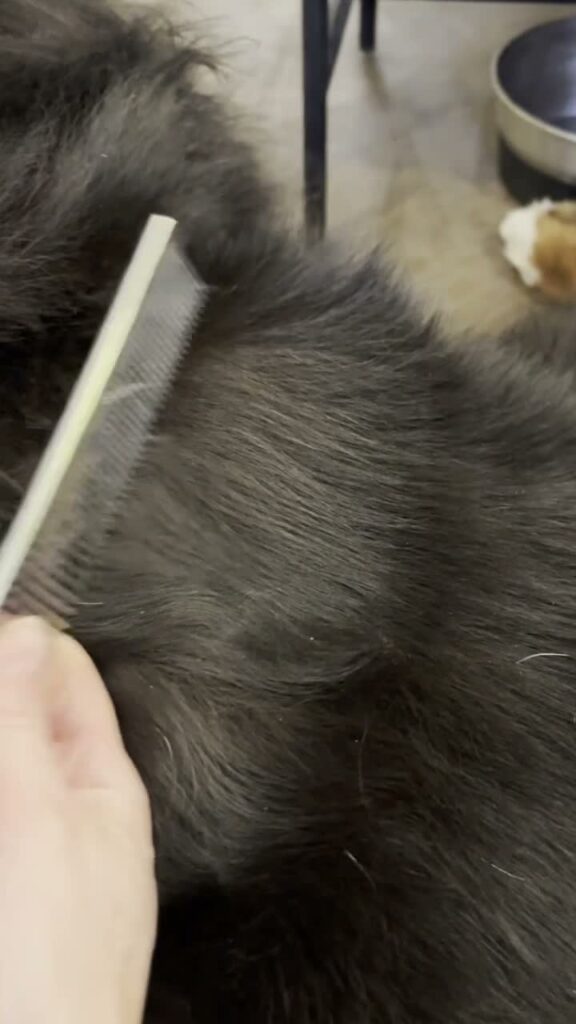
If I took all four dogs to the groomer, it’s $200–$300 per dog. That’s $800–$1,200 every single round. For a double-coated giant breed that needs regular attention, professional grooming is one of the biggest recurring costs nobody mentions at the breeder’s house.
This is exactly why I learned to do it myself — and why I wrote my Big Dog Grooming Guide. One skipped grooming appointment pays for the $9.99 guide about a hundred times over.
Big Dog Grooming Guide — $9.99
The $5,000 Surprises Nobody Warns You About
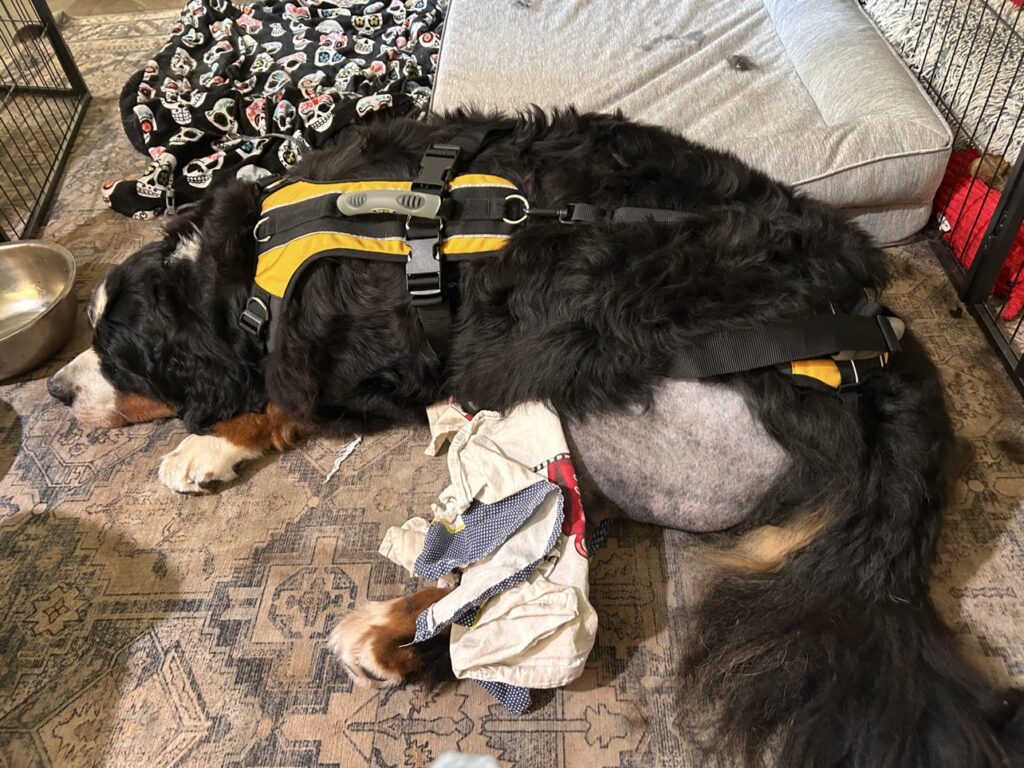
Budget for the annual costs all you want. It’s the emergencies that break people.
TPLO surgery (torn cruciate ligament): $4,500–$6,000 per knee in Ontario, up to $7,000 at the high end. Giant breeds blow knees the way sports cars blow tires — it’s not if, it’s when. I’ve been through this one. And that is just the surgery, it doesn’t include extra items you need (think harnesses for lifting, ramps, pens, throw rugs through your entire house, etc.) and rehab. If your dog ever needs it, my TPLO Recovery Survival Kit walks you through the whole thing for $14.99.
TPLO Recovery Survival Kit — $14.99
Bloat (GDV): The nightmare scenario. A giant dog’s stomach flips, and you’re racing to the emergency vet at 2 AM. Emergency surgery runs $3,000–$8,000. A preventative gastropexy (stomach tacking) costs $500–$1,500 standalone, or a few hundred added to a spay/neuter — ask your vet about it.
Cancer: Bernese Mountain Dogs are tragically cancer-prone — it’s why their average lifespan is only 6–8 years. Treatment easily runs $5,000–$10,000+. This is the conversation nobody wants to have and everybody needs to.
Death by a Thousand Cuts: The Incidentals
Then there’s everything else. None of these are expensive alone. Together, they never stop:
- Ear infection meds — I keep ours on hand permanently; giant floppy ears are infection magnets. Plus ear cleaners and ear wipes for maintenance.
- Allergy management — Grace gets bee pollen in summer, a vet-only ProSeb shampoo, and hydrolyzed food year-round.
- Joint supplements — all four get glucosamine supplements daily. Non-negotiable for giant breeds.
- Sanitary wipes, detangler, deodorizer — the grooming shelf keeps growing.
- Marrow bones and tough toys — giant jaws destroy “indestructible” toys as a hobby.
- The destruction budget — a separate line item for everything they’ve eaten that wasn’t food. Every giant breed owner reading this just laughed and then cried a little.
Keeping It Sane: How to Not Go Broke
Insure early. Get pet insurance the day your puppy comes home, before anything becomes a “pre-existing condition.” Giant breeds are among the most expensive dogs to insure ($55–$105/month for a Bernese) because insurers know about the knees and the cancer. It’s still cheaper than one TPLO.
Learn to groom. $200–$300 per dog per session vs. doing it yourself with a $9.99 guide. The math isn’t close.
Buy in bulk. The biggest bags, the warehouse-store supplements, the case-lot poop bags. Auto-ship options can add savings. Boring, effective.
Find your farm-direct lucky break. Ask around raw feeding groups and local farms. I pay about $335/month to raw-feed four giant dogs because our local supplier’s prices beat the pet stores cold. Your mileage may vary, but it’s worth asking.
Budget for the emergency before it happens. A dedicated pet emergency fund with a few thousand in it turns a 2 AM crisis into a problem instead of a catastrophe.
Frequently Asked Questions
Is a giant breed dog worth the cost?
Financially? Absolutely not. Emotionally? Ask me while a 100-lb Bernese is asleep on my feet. Worth is the wrong question — the right question is whether your budget has room, because the costs are real and they don’t stop.
What’s the cheapest giant breed to own?
Purchase price and food scale with size, but vet costs are driven more by health than breed. A healthy giant from health-tested parents costs less over a lifetime than a cheap puppy with bad joints. The breeder’s health testing is worth every penny.
How much does it cost to feed a Bernese Mountain Dog per month?
$100–$150 on premium kibble, $160–$300+ on pet-store raw. I pay less because our local raw supplier beats pet-store prices.
Should I get pet insurance for a giant breed?
Yes, and get it immediately — before your first vet visit finds anything. Giant breeds are expensive to insure precisely because they’re expensive to treat. One cruciate surgery costs more than years of premiums.
Why does everything cost more for giant dogs?
Anesthesia, medication, and preventatives are dosed by weight. A 100-lb dog needs 5x the drugs of a 20-lb dog. Crates, beds, harnesses, and crates all scale up in price too. There’s no small-dog discount on anything.
For the month-to-month side of pet budgeting, see my post on how I actually afford seven pets.
